Booth Captures Powerful Stories from Patients, Caregivers
A woman with scoliosis, a man living with HIV, and a wife threading the line between spouse and caregiver. These individuals and hundreds like them have shared their experiences in the MyPaTH Story Booth, and so can you at the 2019 PCORI Annual Meeting.
The Story Booth is like a traveling studio. Anyone who wants to share their experience as someone living with a health condition or the caregiver of someone who is can step into the soundproof audio compartment and record their story with a friend or a member of the Story Booth team. Interested storytellers can also arrange to tell their story over the phone.
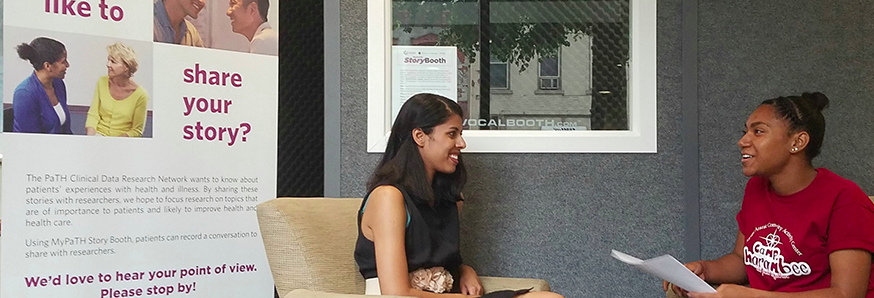
Annual Meeting attendees can stop by the Story Booth to talk about their experiences as a patient or caregiver.
In addition to serving as a vehicle of expression for patients and caregivers, the Story Booth facilitates connections between people who have real-world experience living with a health condition and health researchers, ultimately helping researchers and doctors devise studies and treatments that are centered on the patient. The recordings are edited to remove identifying information before they are shared with researchers (or posted online, if you consent), to help protect participants’ privacy.
A PCORI Engagement Award funds the Story Booth, which is operated by PaTH, a clinical research network made up of academic health systems (in Maryland, Michigan, Ohio, and Pennsylvania) and part of PCORnet, the National Patient-Centered Clinical Research Network. It travels through the PaTH network and will arrive at our Annual Meeting from its home base at the University of Pittsburgh, where the project’s lead researcher, Kathleen McTigue, MD, MPH, MS, is an associate professor in the university’s Department of Medicine.
"I’m excited to be able to bring the Story Booth to a venue where so many patients, caregivers, and researchers come together," McTigue said. "Sharing a story is easy to do and takes less than an hour. Yet stories can be a powerful way to help others to understand a complex problem or to persuade them that change must be made. We hope that meeting attendees will consider taking a break between sessions to have their voices amplified with the Story Booth."
Sharing a story is easy to do and takes less than an hour. Yet stories can be a powerful way to help others to understand a complex problem or to persuade them that change must be made.
Potential storytellers needn’t worry about telling the right story. Whatever aspect of a patient’s or caregiver’s experience they most want told is exactly what the Story Booth team wants to hear. McTigue encourages participants to stop by more than once if there is more than one chapter of the story to be shared.
For Jim Uhrig, one of Story Booth’s earliest recorders, stopping by the booth was just one aspect of his storytelling. He has written a book detailing his journey receiving a lung transplant after being diagnosed with idiopathic pulmonary fibrosis.
“It wasn’t long after my diagnosis that I realized the patient voice is often overlooked in clinical research,” Uhrig said. “With tools like the Story Booth, patients are not only able to share their perspectives through their own words, but they also have the opportunity to connect with one another to share stories, provide support, and form a tight-knit community of like-minded peers.”