Helping Survivors of Breast Cancer Watch Out for Recurrences
There are more than 3 million women with a history of breast cancer in the United States, according to the National Cancer Institute. Around 90 percent of women diagnosed with breast cancer survive for at least five years after diagnosis.
When women have finished treatment, they enter surveillance, during which doctors check them regularly for signs of cancer. For many women at this time, their relief at having survived the initial cancer is mixed with concern. Every follow-up appointment could mean detection of a recurrence. Doctors most often order mammograms to scan for possible tumors and, when an abnormality is suspected, follow up with additional tests such as additional breast imaging and biopsies.
The involvement of multiple stakeholders should help ensure that research results will be used not just by physicians, but by patients as well.
But not all tumors show up on mammograms. So doctors have also begun to turn to magnetic resonance imaging, or MRIs, for some patients who have a higher risk of recurrence. Currently, there’s little evidence about whether MRI adds value compared with mammography for detecting recurring breast cancer. A PCORI-funded study looking for that evidence is one of many projects we’re funding on breast cancer (see box).
In observance of October as National Breast Cancer Awareness Month, we spoke with investigators comparing MRI and mammography as surveillance tools for breast cancer survivors. Karen J. Wernli, PhD, MS, the study’s principal investigator, is an epidemiologist at Group Health Research Institute in Seattle.
Mary Bush and Dianne Johnson are breast cancer survivors who are serving as patient co-investigators on the project. They are, respectively, a retired nurse and a former associate in ministry. PCORI also hosted a Twitter chat on breast cancer.
Why do we need a posttreatment surveillance study?
Karen Wernli: A radiologist told me, “I have lots of patients who had prior breast cancer asking me if they should get a breast MRI. But I don’t know what I should tell them.” That’s an increasingly common problem. We’re working with the Breast Cancer Surveillance Consortium. It’s the largest national consortium of breast imaging data in the United States. When our project began, the consortium had just started to collect information about breast MRI.
Dianne Johnson: There has been a lot of advertising aimed at patients urging us to consider breast MRI for regular screening or surveillance. As a patient, it’s really important to have some good data to base your decisions on, and not just what you see advertised in the paper and on billboards.
Mary Bush: I would second that. Early in the project, Dianne and I would bring in postcards and letters that we had gotten from local imaging centers stressing the importance of MRI and making some claims that we now know were not really accurate. The technology was really advancing, and imaging centers were pushing it.
How have patients’ voices affected the research?
Karen Wernli: The first part of our study was focus groups with women with a personal history of breast cancer, to understand their perspectives on breast imaging. Mary and Dianne came to those meetings as part of the research group. Just having patients on the team come to the focus groups set attendees at ease.
Dianne Johnson: Over time, in our discussions with the stakeholder panel of physicians and the scientific team, they began asking us questions, instead of us always asking them. They asked about what patients’ concerns would be.
Karen Wernli: In one of our first meetings with our stakeholder panel, one of the doctors said that biopsies were no big deal to their patients. And Dianne spoke up and said, “They’re a really big deal.”
Mary Bush: At the end of the first year, a lot of the scientists on the team were focused on mortality data. But we had learned that even though women in surveillance are afraid of having cancer again, mortality isn’t usually their main focus. In a lot of the focus groups, women said they are interested in how surveillance would affect them and their families, whether imaging would be covered by insurance, how much it would cost, and the time required and comfort of the actual imaging methods. By the time we had our last team meeting, the word mortality didn’t even come up—which is great.
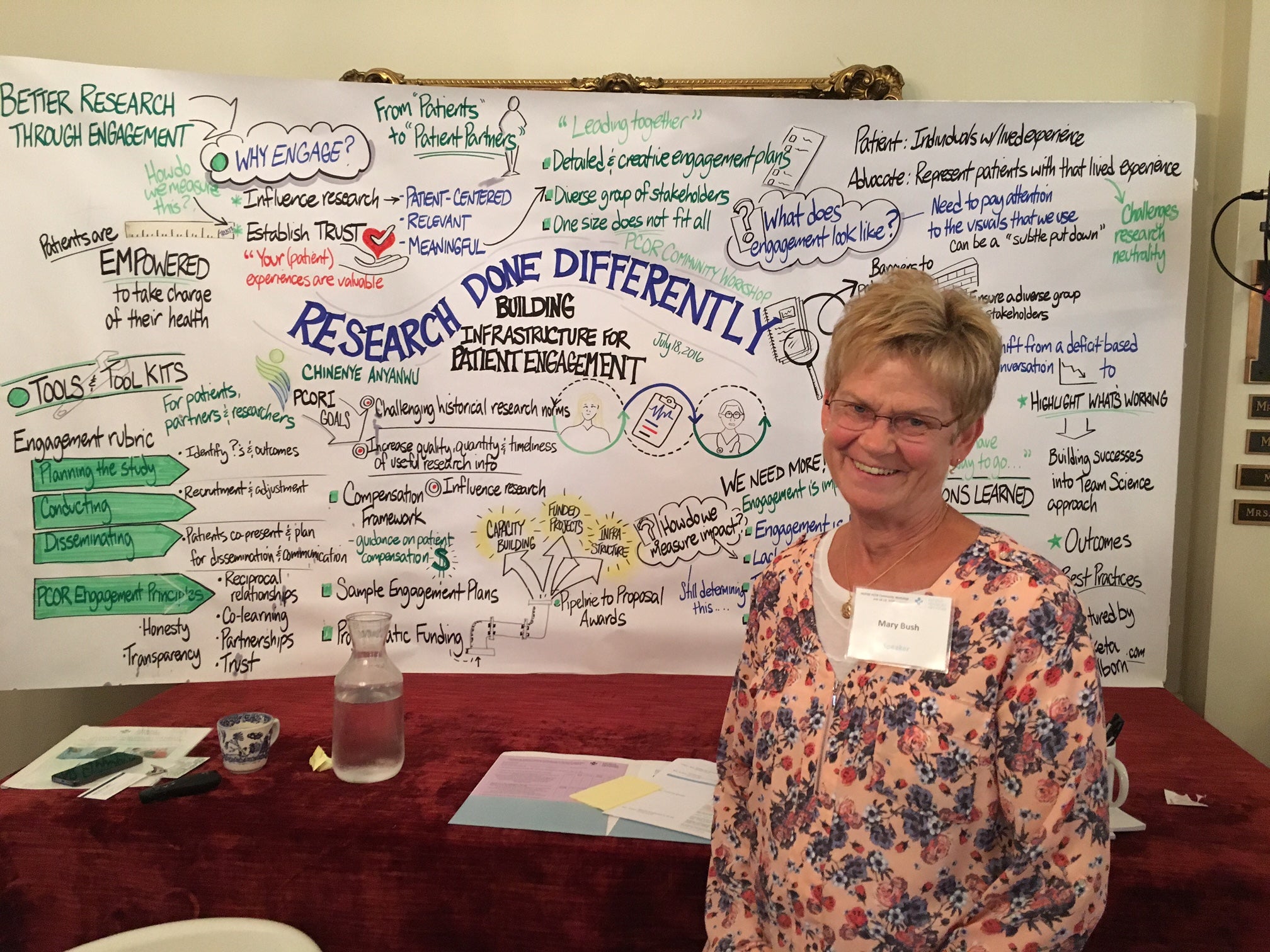
Mary Bush, a patient investigator, stands in front of a visual depiction of a discussion she participated in about patient engagement in research. (Photo credit: Susan Brandzel)
In addition to conducting focus groups, you have also analyzed data from the Breast Cancer Surveillance Consortium. What can you tell us about what you found?
Karen Wernli: We have surveillance data from more than 13,000 women, from more than 30,000 mammograms and 2,500 MRIs. These women were diagnosed with breast cancer between 2003 and 2012. We’ve done a lot of work to see whether cancer was detected, and to understand what the performance of each test was.
Prior research had shown that the ability of breast MRI to detect cancers during screening of women who had never had cancer was higher than mammography. But our preliminary results seem to show that the two approaches might be equally good in surveillance, though MRIs led to more biopsies. That was really surprising to the radiologists on the team.
Will this information be useful to breast cancer survivors?
Mary Bush: In our focus groups, women had definite opinions about which was better, mammography or MRI, sometimes not based on science. Having information like the results of this study will help women make decisions based on evidence.
Dianne Johnson: If you know that cancer is probably equally detectable with either tool, you’re going to feel a lot better about your surveillance decision.
I also think that our study could help women to understand what fits their point of view. Are you comfortable with MRI, if MRIs lead to more biopsies? How many do you want to put yourself through? And it could help doctors understand that there are these different points of view.
Karen Wernli: Part of this project is to fill that knowledge gap, to inform women about the kind of surveillance they might be getting, and what the pros and cons of imaging might be. At the end of the day, the patients have to feel comfortable with the decisions they make with their doctors about their care.
The views expressed here are those of the authors and not necessarily those of PCORI.