How Health Care "Problems" Can Become PCORI Research Questions
During the roundtables and workshops we hold around the country, we’re often asked to talk about the types of research questions PCORI hopes to answer through the studies we fund. I’ve done this a few times and find it a useful way to help people think about the health issues they face, so they can come up with research questions for us to consider.
We know most people don’t have the time to think about what scientific research they need. They see “problems,” not “research questions.” So we appreciate the opportunity to provide a real-world perspective on how to come up with a research question.
This came home to me during a recent regional workshop. The two presenters who followed me on the program had received PCORI funding and talked about how they had decided what to study. They described how they had worked closely with patients to develop questions they would seek to address in their research project. Those questions turned into a funding application that was one of the very first to win approval by our Board of Governors.
So let me share the information I’ve presented on this subject so more people can become a part of our important work. Whatever your interests, you can develop research questions that are important to you—or those you care for. You don’t need a background in medicine or research; your own experiences give you unique insight into the difficult healthcare decisions people face daily.
What Questions Do We Consider?
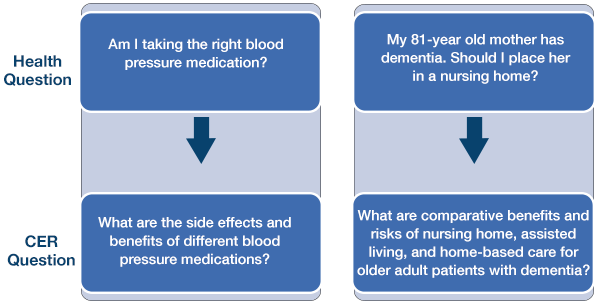
What sort of questions do we look for when we review research proposals? In short, we’re interested in those that people ask when deciding between two or more healthcare choices. Because studies that address these kinds of questions compare different options, they are called comparative effectiveness research (CER). Most importantly, PCORI wants studies that will produce information that allows patients to weigh benefits and risks of treatments according to their individual preferences.
The best research questions lead to a better understanding of what someone can expect from the different healthcare options they have. For example, consider a treatment that leads to the best long-term prognosis but has the potential for side effects that could limit a person’s day-to-day activities. Some people consider the potential risks and benefits of that treatment a fair trade. However, others who highly value their participation in daily activities may be willing to accept a less-favorable outcome.
CER questions typically refer to risks and benefits. Consider this common question: “My 81-year old mother has dementia. Should I place her in a nursing home?” By considering your options and preferences, you can create the following CER question: “What are the comparative benefits and risks of nursing home, assisted-living, and home-based care for older adult patients with dementia?”
Because such research questions can yield valuable information for many patients and their families, they are the type of question PCORI addresses.
How Do We Select among All the Questions?
We give preference to questions that study an issue or condition that is either common or places a heavy burden on patients, their families, and the healthcare system. For example, we are funding studies that investigate effects on cognition of different medications for children with epilepsy, different ways of helping people with low health literacy deal with chronic pain, and types of care planning to enable seniors to stay in their homes.
We also choose projects that are most likely to provide evidence that will change current practices and improve patients’ health outcomes.
We are careful to avoid questions that are outside our scope of work, as defined by our authorizing legislation. PCORI is only charged with finding out what works and what doesn’t in health care. So we don’t fund studies on the causes of disease or how they work.
We also can’t fund research on the cost or cost effectiveness of various options, although we can consider out-of-pocket costs that may affect whether or not a patient adheres to treatment or makes decisions. What’s more, we can’t fund studies of insurance coverage.
 Example Questions: A PCORI-Funded Project
So, how do researchers think about this same process? Let’s get back to the researchers I mentioned earlier – Beverly Thorn, PhD, of the University of Alabama-Tuscaloosa, and Toya T. Burton, DC, MPH, of Whatley Health Services, Tuscaloosa, Ala., and their project on chronic pain.
These researchers were interested in finding out whether group cognitive-behavioral therapy could help rural people with low literacy deal with chronic pain. To determine their research question, Thorn and Burton conducted interviews and held focus groups of patients being treated for chronic pain. The patients agreed that two questions were the most significant:
- What are my options for treating my pain, and what are the benefits and harms of those options?
- What can I do to reduce my pain, interference [with physical activities] due to pain, and feelings of depression?
The researchers then developed testable research questions to address the patients’ questions.
 Example Questions: Workshop Participants
In an exercise at one of our meetings, participants worked in teams to formulate CER questions relevant to their communities. Their final questions included:
- What are the benefits of mental health education programs implemented through a religion-based organization as opposed to a clinical intervention?
- What are the benefits of having depression screening and intervention take place in a primary care practice versus referring patients to external sites?
- For patients with dual chronic conditions, will using a clinical events manager improve delivery of holistic care?
- Does diabetes control improve when comorbidities are addressed?
Now it’s your turn! Please take a few minutes to consider the health problems you and your family have faced. Think about the two or more options you’d like to consider, along with the risks and benefits. Submit your research questions here, and they will be considered as part of our ongoing process of developing topic-specific PCORI funding announcements.
Thank you for your support of PCORI’s work. We hope to hear from you soon.
Hildebrandt is PCORI’s Director of Stakeholder Engagement