Mapping Evidence That Patients Can Use
PCORI puts a tremendous emphasis on funding projects that arm patients and other decision makers with information that can help them make healthcare decisions. But research projects take time to complete. That’s why we are simultaneously developing a suite of information products that can get stakeholders information they want and need sooner.
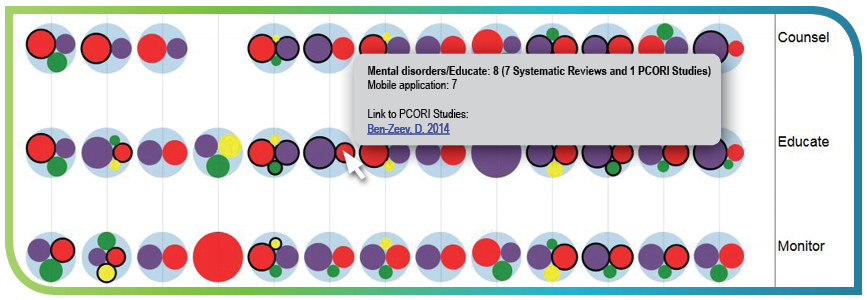
Evidence maps are one such information product. Using many of the same processes as a traditional systematic reviews of the scientific findings, but taking less time to complete, they graphically display what research studies exist on specific health topics—and what evidence gaps remain. We’re excited to unveil two sets of evidence maps, on treatments for fatigue in multiple sclerosis (MS) and the impact of mobile health interventions for self-management of chronic disease. Mobile health (mhealth) is the use of mobile devices, such as smartphones and tablets, to deliver healthcare services and information.
One of our MS maps examines studies comparing the effectiveness of treatments—looking at drugs, exercise, behavioral, and alternative and complementary therapies such as acupuncture—to standard care. We’re also pleased to have two additional MS evidence maps, one looking at the existing literature base to identify evidence gaps by study designs for groups of treatments, and another looking at head-to-head studies of treatments. The MS maps were created, in part, to assist patients and clinicians in making informed decisions based on their individual characteristics and preferences for a condition that has multiple treatment options.
Meanwhile, the mobile health maps are helping PCORI understand how our funded research portfolio of mobile health projects are addressing this topic area, and helping us better understand what evidence gaps still exist.
PCORI approached these topics as learning models, which allowed us to investigate best approaches to developing maps that are interactive, relatively intuitive to use, and as informative as possible.
These first two sets of pilot maps were primarily designed to examine the various types of methodologic issues we encountered as we first began to work with this emerging form of evidence synthesis. PCORI approached these topics as learning models, which allowed us to investigate best approaches to developing maps that are interactive, relatively intuitive to use, and as informative as possible.
We have two additional maps in progress. They focus on treatments for localized prostate cancer and nonsurgical treatments for urinary incontinence in women.
We’ll continue to update you on our progress on this initiative in the coming months, and all of our evidence maps will be publicly available on our website, so please stay tuned. And as always, thanks for your interest in PCORI and your support of our work.