A New Phase in Building PCORI’s National Patient-Centered Clinical Research Network
PCORI’s vision for a National Patient-Centered Clinical Research Network, announced on April 23, is an unprecedented effort to support the development of a research infrastructure capable of leveraging the enormous volume of valuable data that is produced in our health system every day.
By creating a large national network of health data representative of patients across the country, this initiative is expected to improve the nation’s capacity to efficiently conduct patient-centered comparative effectiveness research (CER), to learn from the healthcare experiences of millions of Americans, and to implement what’s learned in clinical practice.
Conducting health research efficiently and effectively requires data that is accessible, easy to use, and maintains patients’ privacy and security. The national network will serve as an important foundation for transforming the nation’s healthcare system into one that is able to constantly learn what works best through studies of data that is collected during patient visits with healthcare providers and then made anonymous and aggregated in central databases. It also will promote broader participation of patients, clinicians, health systems, and payers in the research process and help connect patients interested in participating in studies with researchers conducting trials.
Our first step toward creating this critical infrastructure is to establish funding to build the network’s core components. Coinciding with the initiative’s launch, we released two funding announcements that will invest $68 million to develop or expand up to 26 networks, including as many as 18 Patient-Powered Research Networks (PPRNs) and eight Clinical Data Research Networks (CDRNs).
PPRNs will be groups of patients interested in sharing their health data, exploring new ways to contribute their health information in scientific studies, including the development of research questions, and participating in the development and conduct of studies.
CDRNs will consist of two or more health systems working toward ways to facilitate the effective collection and sharing of secure, anonymous health data for research purposes with demonstrated involvement of patients and clinicians. Having the capacity to support large studies with substantial patient and clinician involvement in decisions about these studies and their results, the CDRNs will also play a role in uniting patients, clinicians, researchers, and healthcare systems in the research process. Health system leadership involvement will be critical in order to implement the results of patient-centered research in routine care.
Pulling it together
On June 5, we announced the next step in building our national data network: plans to create a Coordinating Center that will bring the PPRNs and CDRNs together to achieve our common goal of a national network.
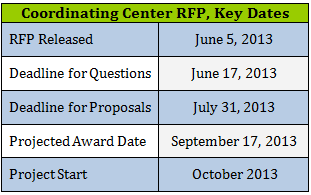
Our Request for Proposal (RFP) seeks an organization that can take a central role in supporting the development of PPRNs and CDRNs and connecting these small networks to begin solidifying the national data infrastructure. The Coordinating Center’s responsibilities fit within five broad categories:
- Program management
- Technical assistance
- National network logistical support
- Cross-awardee communications and coordination
- Program evaluation
The Coordinating Center also will support the national network’s Steering Committee, which is charged with making decisions on policies, best practices, methods, and standards to assure progress toward the vision of an efficient and interoperable network. We look forward to identifying an organization that can carry out these important responsibilities while upholding PCORI’s commitment to patient-centeredness, diversity, and transparency.
Better data, better research, better decision-making
Collecting the vast experiences of patients and those who care for them has the potential to produce rewards for many different stakeholders within the healthcare community. Patients and clinicians will have better information to make decisions, researchers will find new avenues to conduct breakthrough studies, healthcare systems will have the opportunity to learn from the studies, and industry representatives will have new data to evaluate the effectiveness of their offerings.
With these potential benefits at stake, we have high expectations for our plan to create a National Patient-Centered Clinical Research Network. You can learn more about this opportunity on PCORI’s website.