PCORI Advisory Panels: We Asked for Volunteers, and We Got Them
When we ask patients and other stakeholders to participate in our work — and we often do — we’re always impressed by the volume and quality of the responses we receive from across the healthcare community. Our recent call for applications for our first PCORI Advisory Panels was no different.
We established these panels to support three of our scientific programs – Assessment of Prevention, Diagnosis, and Treatment Options; Improving Healthcare Systems; and Addressing Disparities – plus a fourth panel on Patient Engagement. These panels will help us refine and prioritize research questions, provide needed scientific and technical expertise, offer input on other issues relevant to our mission, and help us model full and meaningful patient and stakeholder engagement efforts.
More than 1,000 individuals – 1,021 to be exact – submitted a total of 1,295 applications for slots on these panels (some applied for more than one). It was an encouraging confirmation of the healthcare community’s strong interest in our research priorities.
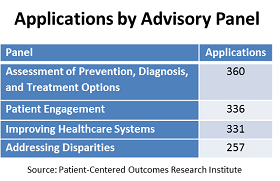
Not only were the applications voluminous, they came from a diverse pool of patients and other stakeholders. So we’re confident we have the ingredients we need to create an initial set of panels representative of the broad national stakeholder community that must help guide our work.
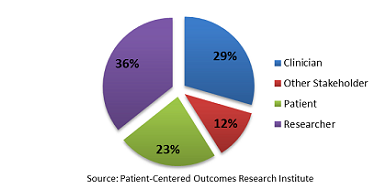
Researchers made up the largest share of applicants (36%), followed by clinicians (29%). We were pleased that nearly a quarter of the applications came from patients, patient advocates or caregivers (23%); the remaining 13% came from a mixture of other stakeholders, including payers, policymakers, purchasers, and industry representatives. Our panels will include representatives from each of these groups, including those specified by law, to see that all appropriate perspectives are reflected in their work.
We were pleased to see geographic diversity in the applicant pool as well. Southern states (including Washington, DC) were the leading source of applications (37%), followed by the Northeast (25%) and Midwest (21%). Another 17% came from the West (California’s 64 submissions were the most from any state). Further evidence of geographic strength in the pool: 10 states submitted at least 30 applications and half of all states submitted at least 10.
Despite our excitement, we recognize the challenge we now face. Our initial panels will have 21 members apiece – the maximum called for in their charters – which means we can pick only 8% of our applicants. With hundreds of exemplary candidates, it will be a difficult winnowing process. But we’re committed to selecting balanced, diverse and representative groups reflective of the overall healthcare community.
Candidate review is now under way. Our staff is reading and assessing every application. As noted in the panel charters, applicants will be evaluated through a systematic process that considers their experience, background, and ability to contribute to our work. Draft slates of candidates for each advisory panel will be reviewed and proposed to our Board of Governors for their consideration and approval on March 26 during a public teleconference and webinar.
 Many highly qualified and dedicated applicants won’t be selected in this round. If you’re one of them, we hope you’ll remain involved with PCORI and participate in the other opportunities to guide our work. You can submit a research question you’d like us to consider for funding, help review research proposals we receive, or attend a workshop or other event to share your feedback in person. We do plan to form additional advisory panels in the future, again through an open application process.
You can visit our Get Involved section for an updated list of all the ways you can contribute to our work, and you can stay up to date on all of our activities by signing up for our email alerts.
The formation of our advisory panels is a major milestone in our ongoing effort to bring the voices of a broad range of stakeholders to our effort to build a robust portfolio of patient-centered comparative effectiveness research. We look forward to continuing that collaborative approach to producing information that will help patients and those who care for them make better-informed health and healthcare decisions.
Beal served as PCORI’s Deputy Executive Director and Chief Officer for Engagement from November 2011 – March 2014