PCORnet: Achievements and Plans on the Road to Transforming Health Research
Two years ago, PCORI began an ambitious journey to find a faster, less expensive, more powerful way to conduct comparative clinical effectiveness research (CER). That’s when our Board of Governors approved an initial $100 million investment in PCORnet, the National Patient-Centered Clinical Research Network.
The goal: work with patients, researchers, clinicians, and healthcare system leaders to build and run a network that can access standardized electronic health record information covering tens of millions of patients to quickly conduct studies addressing the real-world needs of patients and those who care for them.
Today, as we look back on the recently completed 18-month first phase of this unprecedented initiative, we’re pleased by the progress we’ve made, aware of the challenges we’ve faced, and ready to build on our successes as we strive toward research readiness, network growth, and sustainability during the second phase of PCORnet’s development.
Why PCORnet?
PCORnet grew out of the growing recognition within the healthcare community that the current clinical research system, for all of the great advances it produces, is badly in need of improvement. There are many reasons why.
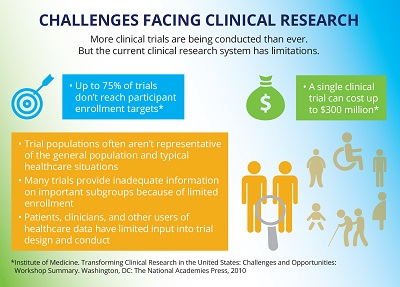
Studies—especially large clinical trials—are currently very expensive and very slow in both setup and conduct. Often, completed studies are not large enough or designed properly to answer the questions most critical to patients. Research teams don’t involve patients who are representative of important population groups. Or studies don’t yield results that can be usefully applied in typical healthcare settings. And many simply fail to answer the practical questions that patients and clinicians face every day.
PCORnet is intended to address these issues by creating a “network of networks” that harnesses the power of large amounts of health information and unique partnerships among patients, clinicians, health systems, and others. In the process, it seeks to transform the culture of research from one directed by researchers to one driven by the needs of patients and other healthcare stakeholders.
Phase I Highlights
PCORnet began as a collection of 29 individual networks—11 Clinical Data Research Networks (CDRNs), based in large healthcare systems, and 18 Patient-Powered Research Networks (PPRNs), based in organizations led by patients and caregivers—plus a Coordinating Center providing logistical assistance.
Their task was to build the infrastructure for a secure national resource of standardized, complete clinical data that research teams could use to efficiently conduct important patient-centered research. In the process, the partner networks had to create processes that would make sure patients and other key stakeholders played a central and meaningful role in how PCORnet is organized and run.
We’re pleased to say that PCORnet and its partner networks succeeded in building out PCORnet’s basic structure, creating models for engaging patients and other stakeholders in their work, laying a foundation for making health data “research ready” while protecting privacy and security, building unique and productive partnerships, and launching a series of demonstration studies. You can read more about these achievements here.
Future Plans
In July, PCORI’s Board approved a second investment, of $142 million, for PCORnet’s three-year second phase of development. These awards will fund the 13 CDRNs and 20 PPRNs that will complete the network so that researchers from both within and outside PCORnet will be able to tap into its capacity to conduct a range of important studies.
Related goals include ongoing refinement of the processes needed to run PCORnet effectively and transform it into an independent network that takes full advantage of the unique partnerships and collaborations formed during Phase I. The work includes cross-network efforts to develop and share new research tools, expand the standardized data resources, develop joint research proposals, respond to a range of queries from others with research ideas and funding, and conduct efficient clinical trials and large observational studies. PCORnet will attract research funding from multiple sources and share the research resources developed with the research community. You can read more about our Phase II goals here.
Facilitating progress toward meeting these new goals will be a new PCORnet governance structure, one that puts more of the day-to-day decision-making authority into the hands of CDRN and PPRN representatives rather than the Coordinating Center or PCORI staff. This new approach grew out of a commitment by PCORI and PCORnet leadership to apply the lessons learned as the network developed to making it work more effectively. You can find out more here.
From Concept to Reality
In a very short time, PCORnet has grown from a theory about how to improve patient-centered outcomes research and CER to a maturing enterprise that will be a powerful national resource for faster, more efficient, and more patient-centered studies.
Already, PCORnet has led to the growth and expansion of many innovative research networks that have pioneered collaborations among clinical scientists, healthcare delivery systems, and patient organizations, thereby illustrating the network’s potential. Demonstration studies now under way will, we believe, further establish PCORnet’s capabilities and efficiencies.
We are confident that the national research community and research funders will see PCORnet as a vital resource worth using and investing in. More importantly, we believe the culture and practices that PCORnet is building can offer a model of research integrated into care delivery and communities that others will adopt. The result will be more efficient studies and more useful results from our national investments in improving health and health care.