Supporting the Safety Net through Research Training and Engagement

Community Health Centers (CHCs), including Federally Qualified Health Centers (FQHCs), provide primary care services to the most underserved populations in the country. These health centers also offer dental, behavioral, pharmacy, and other services to patients who would otherwise be unable to afford them.
Health center patients often have chronic health issues that are compounded by difficulties resulting from social factors. FQHCs, and the state Primary Care Associations (PCAs) which support them, face challenges in meeting the complex health needs of their patients. Given this, Eugene Washington PCORI Engagement Awards teams across the country are helping health center patients and clinicians drive research important to them to better meet these needs.
Building the Infrastructure
Marti Wolf, RN, MPH, became involved in the Southeast Regional Clinicians Network (SERCN)—which seeks to ease health disparities in the southeast—about 20 years ago while working at a health center. She now facilitates partnerships between researchers and health centers as Clinical Programs Director for the North Carolina Community Health Center Association (NCCHA)—North Carolina’s PCA.
She remained connected with SERCN, and saw the chance to spread awareness of the important work of health centers via research being led by Anne Gaglioti, MD, MS.
Gaglioti, Director of SERCN at the Morehouse School of Medicine, has worked in clinically underserved areas most of her career. Working in family medicine and in practice-based research networks (PBRNs), she saw the discrepancy between academic versus clinical practice research priorities. To bridge this divide, she and Denita Walston, MS, Associate Director of SERCN, began their Engagement Award, Engaging Stakeholders to Build Infrastructure for PCOR in the Primary Care Safety Net.
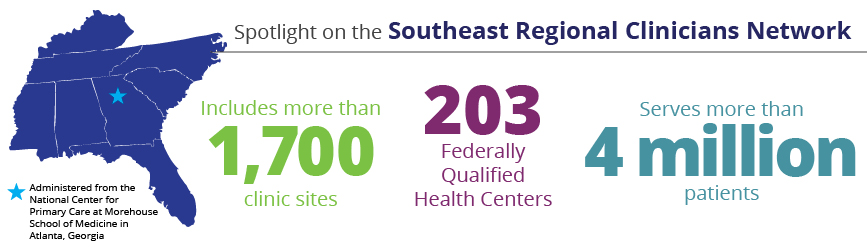
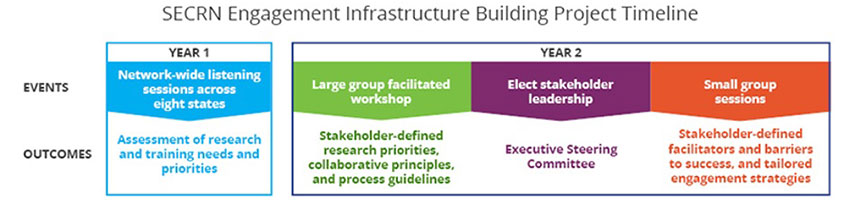
The aim was to improve SERCN’s ability to conduct research aligned with the priorities of safety-net providers and their patients across eight southeastern states, including North Carolina. Health center teams, state PCAs, and other stakeholders from all eight states convened in Atlanta to define a research agenda and sustain their collective PCOR efforts. The resulting infrastructure enabled SERCN engagement with health center patients and clinicians on various projects, including one focused on breast cancer mortality disparities.
Gaglioti said that building trust and relationships among patients, clinicians, researchers, and health center staff was paramount to the project’s success. “Folks who work in the primary care safety net are an incredible source of wisdom and passion. They are there because they are mission driven and they deeply care about the populations that they serve,” she said. “They understand how to build and maintain relationships with communities and collaborators.”
Wolf agreed that building trust was key to getting patients and their stakeholders to truly engage in the research process. “In North Carolina, there is recent history with fairly unethical research, so there’s a lot of sensitivity to the research topics,” she said. “This is a mechanism to help build trust in the process and in the systems and help engage communities into research with topics that are particularly of concern to them, not that are of concern to a researcher.”
Developing Training for Leaders
Jonathan N. Tobin, PhD, President and CEO of Clinical Directors Network, Inc. (CDN), and Co-Director for Community-Engaged Research at the Rockefeller University Center for Clinical and Translational Science, is a cardiovascular epidemiologist who had a dream to design studies that intervened on the health system, physician, and patient levels to change health outcomes. He recognized that patient and clinical partnerships were crucial to addressing the multiple complex medical and social comorbidity of CHC patients. His Engagement Award, Enhancing Community Health Center Patient Centered Outcomes Research Engagement (EnCoRE), worked to build this partnership with an array of organizations to accomplish this vision.
Alongside patients, providers, and leadership staff, he and his team developed 12 monthly webinar trainings, based on CHC stakeholder-identified priorities, to help health centers design and conduct patient-centered outcomes research. Three of the participating health centers put their trainings and teams to the test, using them to develop patient-centered outcomes research and apply for PCORI Pipeline to Proposal Awards. All three of these teams were awarded funding.
Folks who work in the primary care safety net are an incredible source of wisdom and passion. They are there because they are mission driven and they deeply care about the populations that they serve.
Anne Gaglioti, MD, MS Project Lead, PCORI Engagement Award
Dena Moftah, Senior Manager for Business Development and Operations at CDN, worked to ensure that the EnCoRE curriculum and resources reached the hands of those who could put it into practice. “At the root of it, EnCoRE is meant be accessible and it’s meant to be used,” she said. Through marketing and online accessibility, the project continues to be built upon by multiple organizations, including Harvard Medical School Center for Primary Care, Alliance Chicago, and more recently, by the University of Miami Clinical and Translational Science Institute and Health Choice Network.
In turn, clinicians became more sensitized to shared decision-making, emphasizing the voice of the patient in treatment decisions to overcome potential barriers to care.
“Our mission is focused on the patients and underserved patients specifically,” said Moftah. “But if we don’t also focus on the clinicians that are treating patients in these populations, we’re not able to really affect the day to day patient care that goes on.”
Putting Evidence into Practice in FQHCs
Over the years, Nivedita Mohanty, MD, a pediatrician and the Chief Research Officer at Alliance Chicago, has heard many outstanding research ideas from CHC patients and clinicians who did not know how to go about exploring their ideas. To train others in conducting patient-engaged research that addressed CHC patient health needs, she and Elizabeth Adetoro, MPH, Research Manager at Alliance Chicago, built on EnCoRE in their Engagement Award: Collaborations for Health and Empowered Community-based Scientists (CHECS).-
In the first year of their project, they focused on disseminating their online curriculum developed with help from CDN and an advisory board of CHC patients, researchers, and clinicians. In the second year, through a competitive process, the advisory board selected CHC staff and clinician applicants for the next piece of the project, which entailed in-person training and research mentorship.
Mentees, called CHECS fellows, used the training to develop patient-centered research proposals guided by an academic, community advocate, CHC staff, or other mentor who matched their research interests. “I feel that the mentorship piece was probably the most valuable and rewarding part of the project,” Mohanty said. “There was a real synergy in terms of mutual respect and learning between the mentors and mentees.”
The relationships carried over to community health centers as the fellows developed research proposals for their respective CHCs even after the two-year project ended. During the project period, two fellows received funding to support their projects; one of which was an Engagement Award building a LGBTQ+ coalition research network.
The fellows weren’t the only ones to gain insight from this experience. Adetoro agreed that CHECS was a gratifying and valuable experience.
“It really was great to see actual providers, that had really important research questions, have the opportunity to actually develop that question for something that is really important for their patient population,” she said.
Spreading Awareness and Supporting Health Centers
There are a variety of ways to support health centers as they improve the health of underserved patients across the country. Regardless of the method, these projects had the same goal of bringing awareness to the unique health needs of those who might otherwise not be heard and advancing research which informs patients and caregivers in making their life-altering healthcare decisions.