When a Clinician Becomes a Patient
I was 25 when I was diagnosed with multiple sclerosis (MS), five years ago. I was young, an athlete, and an intensive care unit nurse. I had recently begun a competitive graduate program to become a nurse anesthetist. I had been having numbness and other symptoms on and off for quite some time, but I told myself it was just stress and tried not to worry about it too much. Eventually, my strange symptoms became much worse.
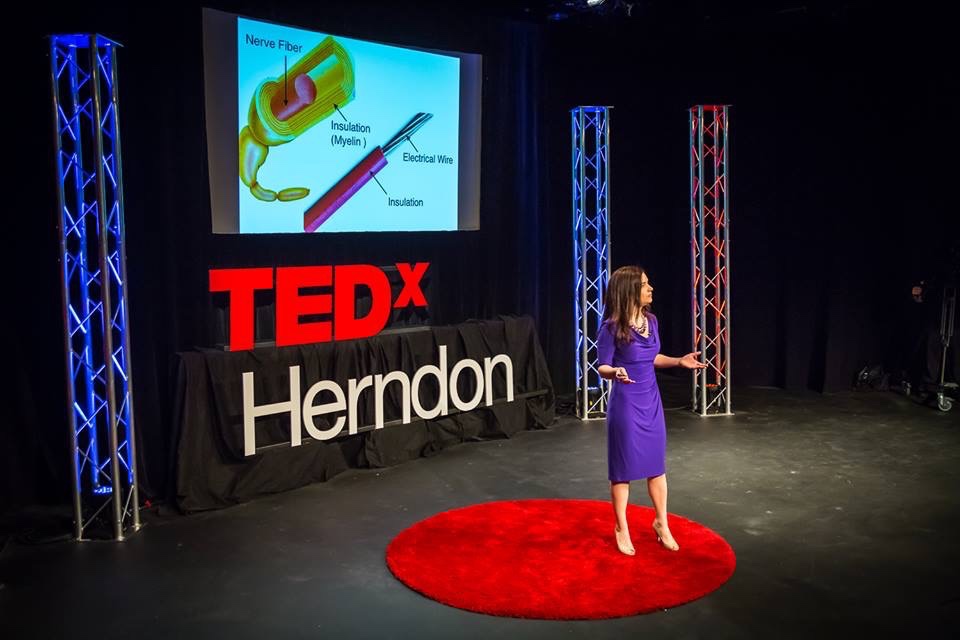
Stephanie Buxhoeveden tells her story of grit in the face of adversity in a TEDx Talk in 2015. (Courtesy of Lindsay Benson Garrett Photography)
One day while I was working out, my right foot fell asleep, and it never woke back up. Over the next couple of weeks, the numbness started creeping up until both of my legs were completely numb. Between work, school, and athletics, my schedule was packed, so I again tried to ignore it. I told myself it was probably just a sports injury.
After studying hard for nearly a year, I was finally starting clinical rotations, where I would learn how to administer anesthesia in the operating room. I was a bundle of nerves that first day, and I barely slept the night before. As I changed into my scrubs, I realized that all sensation from the waist down and in my right arm was gone. Still, I told myself that I was just under a lot of stress and I decided to push through it. In the operating room, I tried to draw medication into a syringe, but my hand was too weak. I looked up at the bright florescent lights and realized they were just a blur. Suddenly, it was clear that my strange symptoms were not just stress or a sports injury, and I finally began to panic a little.
I had walked into the hospital that morning as a healthcare provider, but I didn’t walk back out for over a week. When I did, I left as a patient.
Now, as both a patient and a neurology nurse practitioner caring for others with MS, I want to help find better treatments without all the side effects we now have to put up with. I’ve participated in clinical trials as a patient, and I'm on the membership committee for iConquerMS, the Multiple Sclerosis Patient-Powered Research Network. It's one of the 33 networks of PCORnet, the National Patient-Centered Clinical Research Network. (See Multiple Sclerosis Research Network Builds on Patient Input.)
Using MS Experiences to Help Others
People with MS have extremely variable symptoms and disease courses. (See A Multifaceted Disease Requires a Patient-Centered Response.) I have the relapsing-remitting form of the disease, which means I go through periods when I have new or worsening symptoms. These relapses have caused a lot of damage to my spinal cord, and even when I’m in remission, I deal with aftereffects. I have nerve pain and sensory loss in my legs when I walk even short distances.
Having MS has changed my life in many ways. It has been a challenge. But it has also given my life and career more purpose. After being diagnosed, my first neurologist said that my prognosis was poor and that I should pick a less demanding career. But I finished school—and got a new neurologist.
I’ve been lucky to be able to keep working, even during relapses. I’ve used wheelchairs and canes to get around. I’ve given myself intravenous steroids at my desk during lunch.
In 2013, my new neurologist asked me to come work with her as an MS nurse. I was afraid that it would be discouraging because I’d be caring for a lot of people with advanced disease. But I loved it. Not long after I started, I got a phone call from the mother of one of my patients, who was a teenager and had stopped taking medication. The mother felt powerless as her child’s symptoms got worse.
I hadn’t told any of my patients that I had MS, but I decided to tell the teen. We talked on the phone for around three hours, not just about MS but about life and moms and everyday stuff. I was the first young person with MS that this patient had met. It made a huge difference.
That was a lightbulb moment: I could use my experience to have an impact on the MS community.
Joining iConquerMS has been incredibly empowering. It gives people with MS some of the power and control that MS takes from us.
Joining and Furthering Research Efforts
There are a dozen disease-modifying medications that can control MS relapses and that slow disease progression. I have tried five different medications, but I’ve had a really hard time finding one that will stop my relapses. I need more answers than I have now, and so many of us are in the same boat. iConquerMS is collecting very large amounts of information about its members, not only their data but also their experiences and ideas.
We are working to enroll people with MS into the initiative, build trust within the MS community, and take advantage of PCORnet’s unique way of doing research. By looking at so much information, we might find trends we didn’t know existed. That could lead us to understanding what causes MS and finding ways to manage symptoms that are more practical for patients.
As both a clinician and someone living with MS, I hope that a cure will be discovered in the near future. However, I believe that if we want to find a cure for MS, we first have to understand what causes it. The iConquerMS initiative wants to help us learn more about how and why MS develops, and, importantly, what we can do to help people who have MS right now.
Joining iConquerMS has been incredibly empowering. It gives people with MS some of the power and control that MS takes from us. Being a member of iConquerMS gives me hope because I know that I am helping create a brighter future for myself and my patients.
iConquerMS has about 3,100 people with MS enrolled now. I would like to see everybody with MS take the initiative to have a part in research, even if we’re not experts in medicine or science. Patients don’t realize how much insight we have. Living with this disease makes us the experts. I am looking forward to sharing my experience and expertise at the PCORI Annual Meeting.
The views expressed here are those of the author and not necessarily those of PCORI.